Real Estate & Home
When Will My Patio Be in Shade? A Practical Guide
By SunCast team · Published · Last updated · 8 min read · Markdown
To find when your patio will be in shade, check whether an obstruction lies between the sun and your seating area, then whether its shadow reaches that far. You need the location, date, time, obstruction height and distance to the spot you care about. A patio’s compass direction alone cannot give you a shade time.
The SunCast Shadow Length Calculator lets you explore the height, direction and timing part of that question. Use the interactive version below alongside a sketch or measurements of your patio, then check the result outdoors before fixing furniture or choosing a permanent cover.
TL;DR
- Pick a specific spot and time window: your lunch table, reading chair or evening seating area.
- A shadow must point towards that spot and reach it.
- Compare the dates you actually use the patio; one summer afternoon does not describe the whole year.
- The calculator models one vertical object on level ground. It does not automatically map your house, trees or patio.
Try the shadow calculator for your patio
Use the approximate starting location when available, or search for your town or address, then open the calculator. Start with the height of the wall or building you are checking, select a date and move through the afternoon. Press Play to see how the shadow moves; pause when it points towards your seating area and compare its length with your measured distance.
Explore your patio’s shadow timing
Choose a place, then adjust the object height, date and local time. Compare the shadow’s length and compass direction with your seating area.
Choose a search result to start. Browser location is only requested when you press the button above.
Open the full tool →The block and pillar are simple shapes to help visualise the result. Choosing Block does not load your house or let you draw a wall: the scene is an illustration, not a surveyed model of your property. Rotating the view changes the camera, not the real compass direction of the shadow.
SunCast’s free shadow calculator is useful for a first estimate of how far shade can reach at a chosen time. It combines location-based solar position with object height, and shows the resulting shadow length and direction. Use those values to test a patio layout; confirm the actual boundary against the width and position of real obstructions.
What determines when a patio gets shade?
Three things work together: the sun’s direction, its height above the horizon, and the shape of whatever blocks it. A tall wall may cast a long shadow that misses your table completely; a shorter wall close to the table may shade it earlier.
Solar direction is called azimuth, measured clockwise from true north. Solar elevation is the angle above the horizon, as defined in NOAA’s solar glossary. The shadow points in the opposite direction from the sun.
Start with a simple overhead sketch. Mark north, the house, substantial walls and the seating area. Add trees separately, because their canopy width, gaps and seasonal foliage make them different from solid walls.
| What to note | Why it matters |
|---|---|
| Position of the chair or table | “The patio” may contain sunny and shaded areas at the same time |
| Height of the obstruction | Taller objects cast longer ground shadows at the same sun angle |
| Distance and direction from the obstruction | The shadow must reach the correct place, not just the correct distance |
| Date and local time | Both sun direction and elevation change |
| Ground levels | A raised terrace or sloping garden changes where the shadow lands |
How to estimate when the shade reaches your seat
1. Choose the point you want shaded
Mark the centre of a chair, the edge of a dining table or a corner of the paving. If you want everyone at a table shaded, check its far corners too. The first patch of shade appearing on the patio is rarely the moment the whole table becomes usable.
Write down the intended time window. “Shade while we eat between 17:00 and 19:00 in July” gives you something concrete to test. A breakfast spot may need a different position altogether.
2. Identify the obstruction in the sun’s direction
Use the sun position map to understand where the sun will be, then compare that direction with the site. A fence behind your chair cannot shade you from sunlight arriving from the opposite side of the garden.
For a wall, consider the part that actually lies along the line between the sun and the seat. Sunlight may pass around the end of a short wall even when its calculated shadow length looks sufficient. Roof ridges, eaves and extensions can each create a different shadow edge.
3. Enter its height and compare the distance
Measure or estimate the obstruction’s height above the receiving ground. Keep the units consistent: the calculator supports metres and feet. For a flat-roofed structure on level ground, the relevant top edge is straightforward; a pitched roof needs more care because the ridge sits back from the wall.
For a thin vertical obstruction, the ground shadow length is:
Shadow length = object height ÷ tan(sun elevation).
This is right-triangle geometry, not a promise about a particular property. The tool’s numerical length runs from the object’s base centre to the projected top centre; the shaded 3D footprint also includes the object’s width. For a real wall, trace the shadow from the relevant top edge to the ground below it.
4. Move through time and check direction again
Scrub slowly through your intended window. Record when the shadow is long enough and points towards the seat, then look at the times immediately before and after. The shadow turns as well as lengthens, so a seat can enter shade and later return to sunlight.
For a long straight wall, compare the distance along the shadow’s direction. If the sun strikes the wall at an angle, the shadow length is not the same as the perpendicular distance out from the wall. An overhead sketch helps avoid that misleading shortcut.
5. Repeat for other dates and confirm outside
Test a date near the start and end of your patio season as well as midsummer. NASA explains that Earth’s tilted axis produces opposite seasons in the two hemispheres. June and December therefore make useful contrasting checks, but which represents summer depends on where you live.
On a clear day, photograph or mark the real shadow edge during the relevant window. Compare that with your estimate and correct uncertain heights or distances. Our guide to mapping garden sun exposure gives you a wider observation workflow if several areas need checking.
Worked example: a 2-metre wall beside a patio
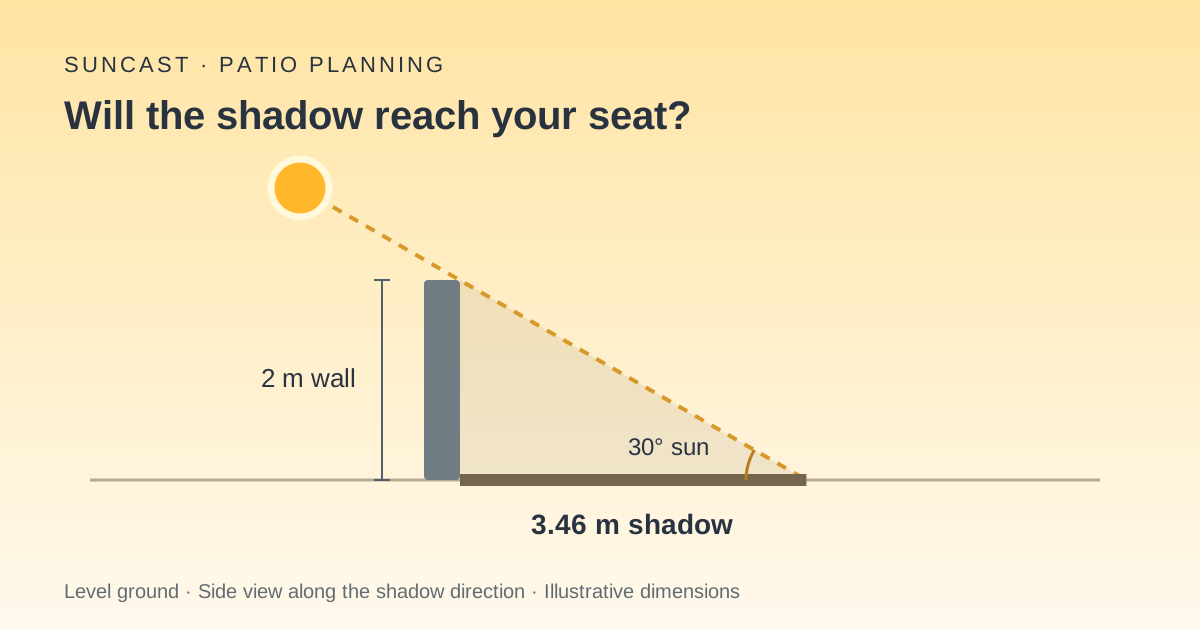
Suppose a seat is 4 metres behind a 2-metre wall on level ground, directly along the shadow direction. Assume the wall is wide enough that sunlight cannot pass around its ends. These are hypothetical dimensions, not a prediction for a named location.
| Sun elevation | Ground shadow from a 2 m wall | Does it reach a point 4 m away? |
|---|---|---|
| 45° | 2.00 m | No |
| 30° | 3.46 m | No |
| 26.6° approximately | 4.00 m approximately | At the boundary |
| 20° | 5.49 m | Yes, if aligned |
The threshold comes from arctan(2 ÷ 4) ≈ 26.6°. The calculator helps you find when the sun reaches that elevation at your location on your chosen date. You still need to confirm that its direction puts the seat behind the wall.
These figures are calculated from the formula above and rounded to two decimal places. They describe shade on the ground. At a hypothetical seated head height of 1.2 metres, only 0.8 metres of that wall remains above the point being shaded; at 30° elevation, its reach at that height is approximately 1.39 metres, not 3.46 metres.
That difference explains why shaded paving can still leave a person in direct sun. For seating comfort, check the height of the person as well as the position of the chair.
What changes with trees, pergolas and raised patios?
The same sun direction matters, but the simple vertical-object model has limits:
- Trees: height alone cannot describe a canopy’s shadow. The Royal Horticultural Society distinguishes dappled shade from heavier shade; gaps between leaves can leave sunlight moving across a table.
- Seasonal foliage: the US Department of Energy’s landscaping guide explains how deciduous trees admit more sunlight after losing their leaves, while dense evergreens can provide shade throughout the year. A summer canopy should not be treated as a solid winter wall.
- Pergolas and parasols: an overhead surface casts a displaced patch of shade, and slat gaps matter. The block represents a solid object rising from the ground, so it cannot predict the coverage of an open-sided roof or fabric canopy.
- Raised or sloping patios: a shadow calculated on level ground can meet a different height sooner or later. Check the vertical difference between the obstruction’s base and the actual receiving surface.
If you are deciding where to put movable chairs, an estimate followed by observation is a useful starting point. If you are sizing a permanent structure, use the actual roof, opening and ground geometry rather than treating the calculator’s block as a construction drawing.
Avoid false precision near sunset
Very low sun produces very long shadows, so a small error in height or solar elevation can make a large difference to the far edge. NOAA’s calculation notes also explain that atmospheric conditions affect observed solar position and horizon timings. A result with decimal places should not be read as a centimetre-accurate survey.
The animated sun is enlarged for visibility and fades below the scene’s plane. Near the horizon, treat that animation as illustrative; use the numerical readout and a site check for the planning decision. Once the calculated sun centre is at or below the horizon, the tool stops reporting a finite shadow length.
Your useful result is a time window for a particular seat, date and obstruction—not a universal “patio shade time”. Start with one spot in the shadow calculator, record its likely window, then test it on the patio before moving on to the rest of the space.
Frequently asked questions
Does a west-facing patio always stay sunny in the afternoon?
No. Its aspect describes the direction it faces, but a wall, building or tree can block afternoon sunlight. Check the sun direction against the actual obstructions and the position of your seat.
Can the calculator tell me when my whole patio is shaded?
It calculates the length and direction of a vertical object’s shadow on level ground. It does not know your patio outline or surrounding buildings, so you must compare the result with the site. A first shaded corner and a fully shaded seating area are different thresholds.
Will a shaded patch of paving keep my face out of the sun?
Not necessarily. A wall’s shadow reaches farther along the ground than it does at head height. Check sunlight at the height where you sit as well as on the paving, especially when the sun is low.