Location
London, United KingdomDate & time
Europe/London
Sun position
Shadow length
One vertical object on level ground; the line runs from its base to its shadow tip. Zoom in to inspect it. Surrounding buildings are not simulated.
Shadow length: 4.622 m
Shadow direction: N · 4.104°
Compare sun paths
Coloured lines show each date on the sun-path diagram. Numbers identify the comparison paths. Readouts use the main date.
Sun times
Sun calculator: sun position and direction on a map
The SunCast sun calculator shows where the sun will be throughout the day: its compass direction, height above the horizon and daily path. The current map location is London, United Kingdom. Change the location and date to plan your own view.
How to use the sun calculator
Find your address
Search for a city, address or place, or move the map to centre it on your location. Switch to satellite imagery to recognise a roof, garden or photo spot.
Choose a date and time
Move the time slider to follow the sun’s position across the day. Times use the selected location’s time zone. Read the sunrise and sunset bearings below to see where the day begins and ends.
Compare the seasons
Keep the same location and choose dates in June and December to compare the sun’s path. Check the same local time on each date to see how direction and elevation change.
Planning sunlight at a house or garden
Compare the sun’s direction with the side of your house, window or garden you want to check. A lower sun can cast longer shadows, so winter and summer views can differ substantially. The 3D view helps you explore the daily path; it does not calculate which buildings, trees or hills block the light.
Use the map for direction and sun position. It does not predict cloud cover or indoor brightness, and shadows visible in satellite imagery belong to the photograph, not your selected time.
Sunrise
06:58
ESE (114°)
Sunset
16:32
WSW (247°)
Azimuth
184°
at 12:00
Elevation
23°
at 12:00
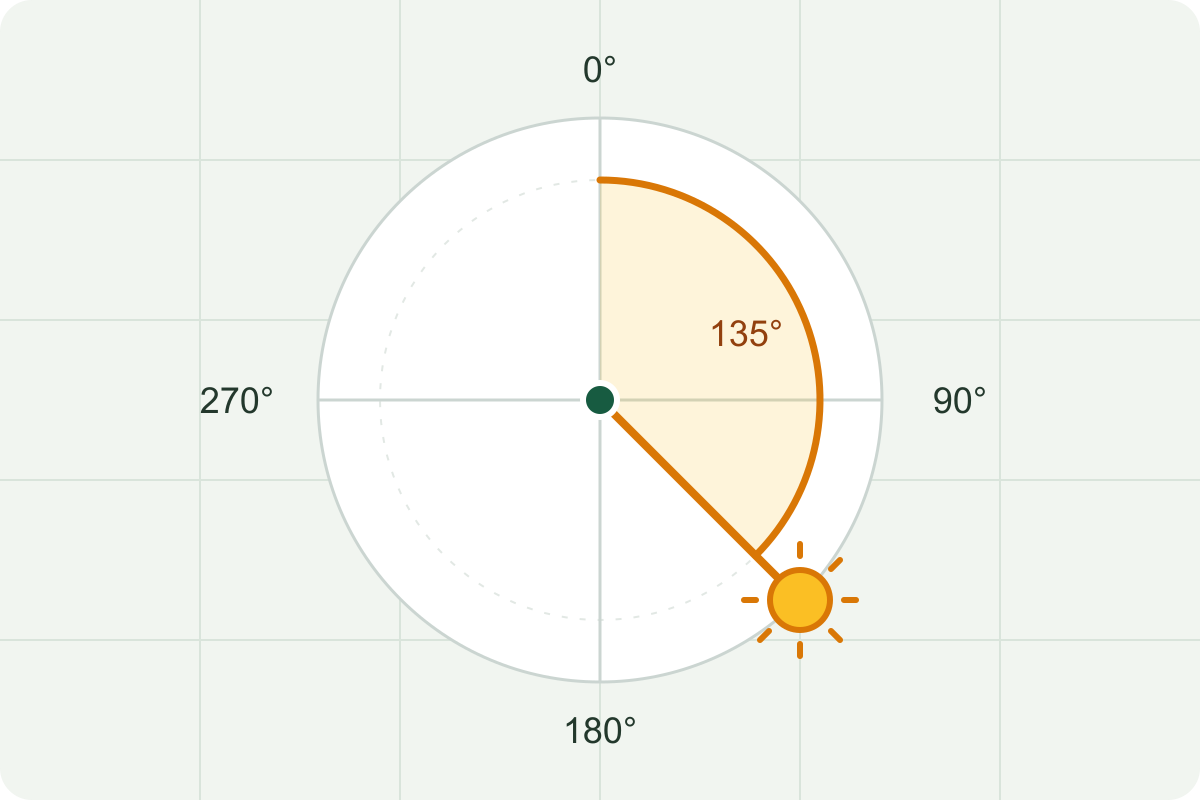
Reading sun direction on the map
Example: a sun bearing of 135° points south-east. Bearings run clockwise from true north (0°), through east (90°), south (180°) and west (270°). This diagram explains direction; use the map above for your chosen place and time.
Sun direction (azimuth)
The compass bearing measured clockwise from true north. The map draws it as a ray so you can see where the light falls.
Sun elevation
The angle above the horizon. A lower sun creates longer shadows; a negative value means the sun is below the horizon.

Plan sunlight anywhere
Overlay the sun’s path on the real sky in AR and see terrain and building shadows for any place and day.
Download on the App StoreKeep exploring
Sun calculator FAQ
Link format for websites (English) →What does the sun calculator show?
Pick any place on the map and any date and time, and the calculator shows the sun’s direction (azimuth) and height above the horizon (elevation) at that moment, plus where it rises and sets. It answers “where will the sun be, here, at this time?” — useful for planning photos, gardens, solar panels or which way a room faces.
What is sun azimuth?
Azimuth is the sun’s compass direction, measured in degrees clockwise from true north: 0° is north, 90° east, 180° south and 270° west. So an azimuth of 120° means the sun sits in the south-east. The calculator draws this direction as a ray from your point on the map.
What is sun elevation (altitude)?
Elevation, or altitude, is the sun’s angle above the horizon: 0° at the horizon and 90° directly overhead. It is highest at solar noon and negative when the sun is below the horizon. Elevation is what determines how long shadows are — the lower the sun, the longer the shadow.
What is the sunrise direction at my location?
Search for your address or drag the map, and the calculator shows the sunrise and sunset directions for that spot on the chosen date. The sun only rises due east (90°) around the March and September equinoxes. In London it rises at about 49° (north-east) in late June and about 129° (south-east) in late December; in New York the range is about 58° to 121°. South of the equator it runs the other way, rising south of east in December and north of east in June.
Can I use it to plan shadows or sunlight on a property?
Use the map to check the direction and height of the sun at a property. The web calculator does not calculate whether buildings, trees or terrain block direct sunlight, and its 3D view is a sun-path view, not a shadow simulation. The SunCast app offers a separate shadow map for buildings and terrain.
Why a map instead of just a table of times?
A table gives times; a sun direction map adds location and orientation. Compare the sun’s bearing with streets, a roof or your chosen photo location to plan light direction. The map does not measure obstructions or indoor light. For a full daily schedule, use the Sun Times calculator.
How do I calculate shadow length?
Open Shadow length and enter an object height in metres or feet. For a vertical object on level ground, shadow length equals height divided by the tangent of the sun’s elevation. At 45° elevation, a two-metre fence casts a two-metre shadow, pointing opposite the sun. This does not simulate neighbouring buildings or terrain.
How do I use the current time or share a plan?
Now sets the date and time to the current local time at the selected map location. Copy link saves your chosen location, date, time, map settings, object height, units and seasonal comparison. Opening the link restores that plan; it does not start live tracking.
What do the seasonal reference paths show?
Compare solstice paths adds the June and December solstice paths for the selected year, using the location’s local dates. They are seasonal references, not an exact annual envelope. The selected day stays gold; June uses cyan dashes and December purple dots. Only above-horizon reference segments are drawn, so a polar-night path may be absent.