Outdoors
How to Plan a Winter Hike Around Short Daylight
By SunCast team · Published · Last updated · 7 min read · Markdown
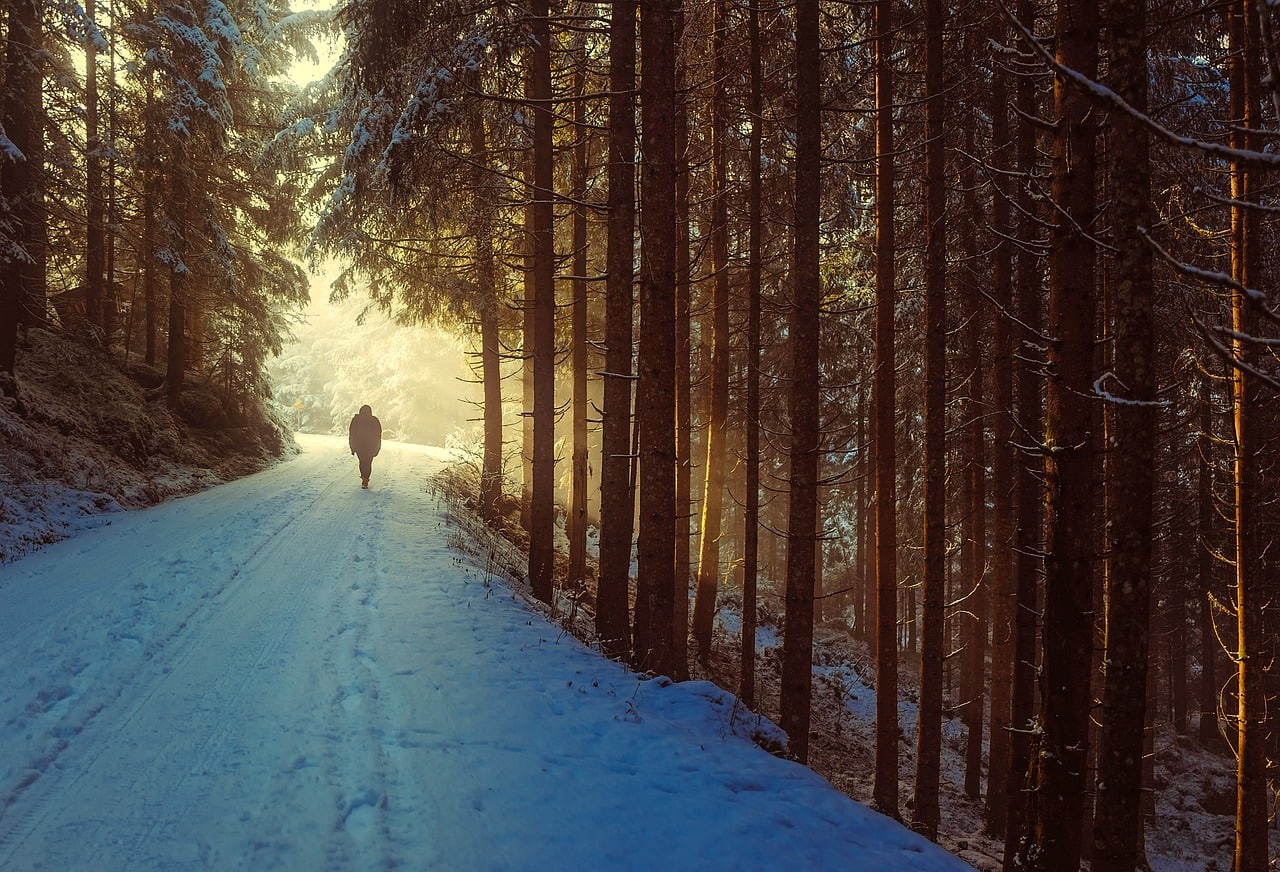
A winter hike runs to a fixed deadline. At the winter solstice, Edinburgh gets under seven hours between sunrise and sunset and Oslo under six, and both the sunset time and the light in the last hour depend on the terrain around you. Plan the route around that deadline first, then choose how far to go.
Quick answer
To plan a winter hike around short daylight, look up sunrise, sunset and the end of civil twilight for the date. Estimate the route time generously, since winter walking is slower. Aim to finish by sunset, set a turnaround time, and check whether ridges or valley walls will block the low sun before the official sunset. Always carry a head torch.
How much daylight you get in midwinter
These figures are for 21 December 2026, the winter solstice in the Northern Hemisphere, calculated with SunCast’s sun position calculations and rounded to the minute.
| Place | Sunrise | Sunset | Daylight | Civil twilight ends | Sun’s height at noon |
|---|---|---|---|---|---|
| Oslo | 09:19 | 15:13 | 5 h 54 m | 16:10 | 7° |
| Edinburgh | 08:43 | 15:40 | 6 h 57 m | 16:28 | 11° |
| London | 08:05 | 15:54 | 7 h 50 m | 16:34 | 15° |
| Seattle | 07:56 | 16:21 | 8 h 25 m | 16:57 | 19° |
| Denver | 07:18 | 16:39 | 9 h 21 m | 17:10 | 27° |
North of the Arctic Circle the sun does not rise at all. In Tromsø on the solstice, civil twilight gives only about four hours and twenty minutes of usable light, from 09:32 to 13:54.
The last column matters as much as the first three. At noon in Edinburgh the sun is only about 11° above the horizon, so a hillside or ridge of modest height can hide it for much of the day.
See how much daylight your month has
Choose your trailhead to see the shortest and longest days of the month and how daylight and twilight change through the year.
Choose a search result to start. Browser location is only requested when you press the button above.
Open the daylight calendar →What civil twilight gives you, and what it does not
The US Naval Observatory defines civil twilight as the period when the sun’s centre is between the horizon and 6° below it. During civil twilight there is generally enough natural light for ordinary outdoor activity; after it ends, you normally need artificial light. The observatory adds that cloud, atmospheric conditions and the visible horizon all change how much light you actually get.
Civil twilight lasts longer the further you are from the equator. On the solstice it runs about 30 minutes after sunset in Denver, 40 in London, 47 in Edinburgh and 58 in Oslo.
Treat that time as a safety margin for the walk out, not as part of the plan. In a forest, a gully or under heavy cloud, the light fails sooner. On rough or icy ground, poor light slows you down at exactly the moment you are tired.
Step 1: Look up the times for your date and start point
Check sunrise, sunset and the end of civil twilight for the trip date, not a general winter figure. Day length falls by several minutes a day in early winter, and the clocks going back in late October moves every time an hour earlier.
The Sun Times calculator shows sunrise, sunset and civil, nautical and astronomical twilight for a chosen place and date. The sunrise and sunset calculator adds the compass bearing of sunset, which you need for Step 4.
Step 2: Estimate the route time, then add winter time
Naismith’s rule is the usual starting point for walkers in Britain: allow about 12 minutes per kilometre plus 10 minutes for every 100 metres of ascent. It assumes fit walkers in normal conditions and does not include stops.
Winter adds time. The Appalachian Mountain Club’s winter hiking guidance says that virtually every hike takes longer in winter. Snow, ice, putting on crampons or microspikes, shorter rest stops in the cold and slower descents on frozen ground all add up. There is no reliable single percentage, so be generous and use your own experience on similar winter routes.
Step 3: Set a finish time and a turnaround time
Aim to be back at the car, or at least on easy, well-marked ground, by sunset. That leaves civil twilight as a buffer for delays.
Then set a turnaround time: a clock time at which you head back wherever you are. The AMC advises setting one even if it means not reaching your destination. Work it out from the time the return leg needs, counted back from your planned finish.
Take Edinburgh on 21 December, where sunrise is 08:43 and sunset 15:40. A route estimated at five and a half hours with winter allowances and stops, starting at 08:45, finishes around 14:15. That leaves almost an hour and a half before sunset for slow sections and another 48 minutes of civil twilight after it. If the return leg takes two and a half hours, a turnaround time of 12:45 still brings you back by about 15:15.
Step 4: Find out where the sun will actually set for you
The published sunset assumes an open horizon. In the hills, the sun disappears when it drops behind the nearest high ground in the direction of sunset, which can be well before the official time.
In the Northern Hemisphere, the winter sun rises in the south-east, stays low in the southern sky and sets in the south-west. A ridge or mountain on the south-west side of a valley can put the valley floor in shade an hour or more before sunset.
Fort William on 21 December shows how little height that takes. Sunset there is at 15:42 and the sun peaks at under 10° above the horizon at 12:19. If the skyline to the south-west rises 5° above level, the sun drops behind it at about 14:33, more than an hour early. If the ground to the south rises 8°, direct sun reaches you only between about 10:58 and 13:40. Anywhere the southern skyline is higher than 10° gets no direct sun at all that day. (Calculated with SunCast’s sun calculator, GMT.) The Juneau avalanche advisory notes that north-facing slopes receive very little heat from the sun in midwinter. Avalanche.org explains that whether a slope gets sun depends on its aspect, its angle and shade from trees or surrounding terrain. In the Southern Hemisphere the pattern is reversed, with the low winter sun in the northern sky.
Practical checks:
- Find the sunset bearing for your date and look at the map in that direction. Any ridge, summit or forest edge there will shorten your afternoon.
- Expect the last stretch of a walk along a north-facing valley or under a north-facing face to be in shade, cold and possibly icy long before sunset.
- If you can choose the direction of a circular route, try to finish on open, sunny ground rather than in a deep valley or dense forest.
SunCast’s hiking tools show terrain shadows moving across a 3D map through the day, so you can see when a particular valley or slope will fall into shade. On the trail, the live AR view shows the sun’s remaining path against the real skyline. For more on how terrain delays the morning sun, read why sunrise is later than the published time.
Step 5: Plan for the cold that follows sunset
Temperature drops quickly once the sun goes down. The Met Office explains that after sunset the ground loses heat by radiating it to the sky, that heat escapes faster on clear nights, and that cold air drains downhill and pools in valleys. A clear, still winter evening in a valley is often the coldest part of the trip, and it arrives just as you are tired and moving more slowly.
Keep a warm layer accessible for the last hour rather than buried in the pack, and expect wet ground and puddles to freeze on the walk out.
Step 6: Carry light, even on a short walk
Mountaineering Scotland’s safety advice describes a fully charged, good-quality head torch as vital. If you expect to be out in the dark, it recommends a second head torch and spare batteries, and being able to navigate off the hill in the dark.
Darkness is a common factor in rescues. Scottish Mountain Rescue’s 2025 statistics record darkness as a condition in 101 incidents, alongside 60 incidents where people were lost and 13 where they were benighted. In England and Wales, Ordnance Survey reported that 78% of mountain rescue call-outs in 2024 came after midday, with mid-afternoon busiest as people come down off the hills.
A short checklist before you go
- Sunrise, sunset and end of civil twilight for the date and place.
- Route time from Naismith’s rule, plus winter allowances and stops.
- Planned finish at or before sunset, with a written turnaround time.
- Sunset bearing checked against ridges, valleys and forest on the map.
- Head torch, spare light or batteries, and a warm layer to hand.
- Someone at home who knows the route and your expected finish time.
Short days leave little room for a late start or an optimistic route time. For summer conditions, see our guide to finding shade on a summer hike.
Frequently asked questions
How long is it light after sunset in winter?
Civil twilight, when there is usually enough natural light for walking on easy ground, lasts about 30 to 60 minutes after sunset in winter at mid and high latitudes. It is around 30 minutes in Denver, 40 in London, 47 in Edinburgh and almost an hour in Oslo at the winter solstice. Cloud, trees and a blocked horizon shorten the usable light.
What time should I start a winter hike?
Work backwards from sunset. Estimate the route time, add time for winter conditions and stops, and aim to finish before sunset rather than at the end of twilight. In many cases that means starting at or soon after first light.
What is a turnaround time on a hike?
A turnaround time is a clock time, set before you start, at which you turn back wherever you are. In winter, base it on sunset and the time needed to return, so you can reach easy ground before dark even if you have not reached the summit.