Real Estate & Home
Which Way Does My House Face? Compass & Map Guide
By SunCast team · Published · Last updated · 5 min read · Markdown
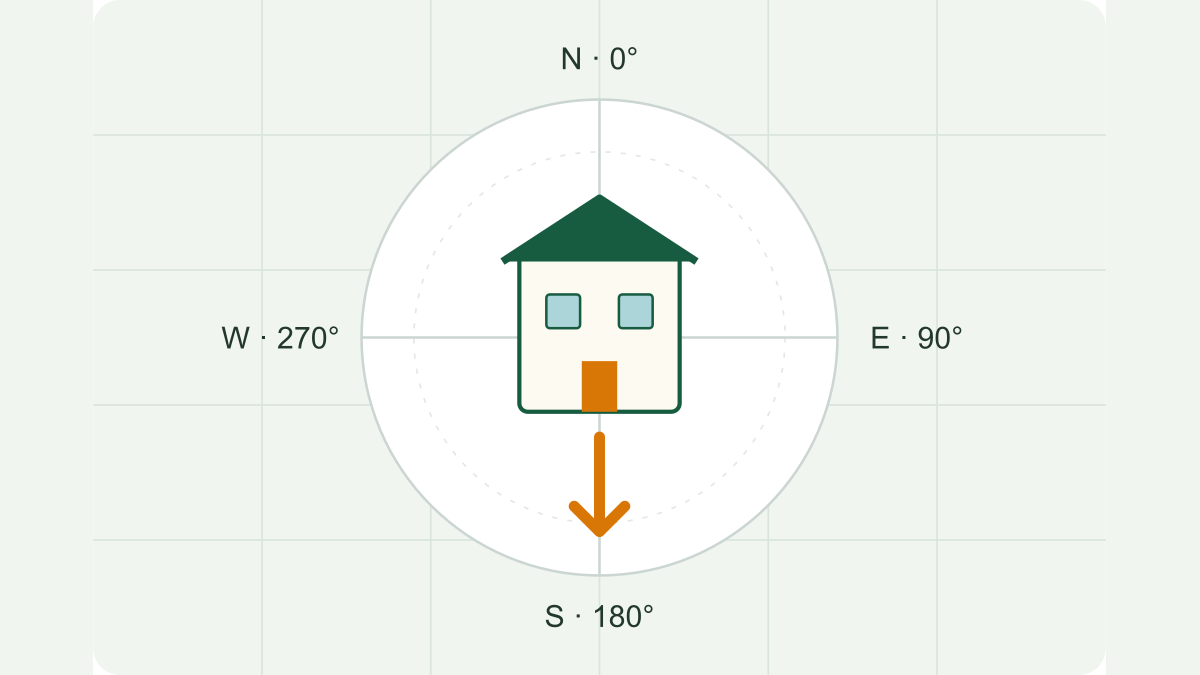
To find which way your house faces, stand at the front door facing outwards and read your phone’s compass. North is 0°, east is 90°, south is 180° and west is 270°. For a room’s sunlight, measure the direction its main windows look out instead.
The illustration above shows the distinction: its arrow points out of the front door towards south (180°). It describes that doorway, not every window in the house. A north-facing entrance can belong to a home with a south-facing living room.
Try it at your address
Have the address? Start with the map
Choose your address to open a satellite map with a compass. Find your front door or window first, then explore sunlight when you’re ready.
Select an address suggestion, then show the map. For a town or area, you’ll need to zoom in to find your building.
Open the full calculator →Choose how to find your house’s direction
- I’m at the property — use your phone’s compass at the door or window.
- I only have the address — open your property on the map, or follow the satellite-map instructions.
- I already know the direction — use the map above and select Explore sunlight.
At the property: use your phone’s compass
- Choose the face you mean. Use the front door for the home’s entrance direction, or the main window for the room you want to assess.
- Face outwards. Hold the phone flat, with its top edge pointing straight out through the doorway or window. Do not point along the wall.
- Read the bearing. A reading near 90° means east; 180° means south. Intermediate bearings describe directions such as south-east (135°).
- Check for interference. Move away from metal frames, magnetic accessories and appliances if the reading is unstable. Repeat the measurement from another safe position facing the same way.
- Record the room and direction together. “Living-room window: south-east” is more useful than simply “south-east house”.
Phone compasses can use magnetic or true north. Use true north when available to compare with the solar bearings in our calculator. Apple’s iPhone compass guidance explains how to hold the phone and warns that magnetic or environmental interference can affect accuracy.
Only have the address? Use a satellite map
- Search for the address in your preferred map service and switch to satellite imagery.
- Reset the map to north-up. Check its compass rather than assuming the map has not been rotated. With north up, east is right, south is down and west is left.
- Identify the correct façade. Use listing photographs or a floor plan to locate the front door or the room’s windows. The road alone does not tell you which way a particular room faces.
- Imagine an arrow pointing straight out from that wall. An arrow towards the right of a north-up map points east. An arrow towards the lower-left points south-west.
- Treat unclear outlines as uncertain. An obscured roof, shared entrance or angled façade can make a satellite estimate ambiguous. Confirm with a compass at the viewing.
A building’s facing direction and the sun’s direction are different measurements. Your window keeps the same orientation; the sun’s bearing changes with location, date and time. The next step is to compare the two.
Check the sun’s direction at your address
Use the address shortcut above to find your property, switch to Explore sunlight and compare a morning and afternoon time. Then compare June and December. The calculator uses the selected location’s time zone, so the time refers to the property rather than your own device’s location.
You can also use the full sun position calculator. It shows the sun’s compass bearing and height above the horizon. It does not automatically identify your window direction, calculate indoor brightness or determine whether a neighbouring building blocks the sun.
How to interpret the result
Compare the sun bearing with the outward direction of your window. Sun on that side of the building is a reason to investigate further, not proof that the room receives direct sunlight: the sun must also clear nearby buildings, trees, overhangs and the window opening.
For homes outside the tropics, these are useful starting points:
| Window direction | What to investigate |
|---|---|
| East | Morning sunlight, including whether nearby buildings block the early sun. |
| West | Afternoon and evening sunlight, plus glare and unwanted heat. |
| South | In the Northern Hemisphere, access to winter sun; check the height of obstructions opposite. |
| North | In the Northern Hemisphere, indirect daylight and the room’s view of open sky. |
Reverse the north/south guidance in the Southern Hemisphere. East still corresponds broadly to morning and west to afternoon; exact sunlight hours depend on season, latitude and obstructions. The US Department of Energy’s daylighting explanation discusses north-facing daylight and the heat and glare challenges of east- and west-facing windows.
For a fuller comparison, see north-facing versus south-facing homes. That guide helps you interpret an aspect once you have measured it.
Three examples to try at a viewing
These are illustrative situations, not measured properties or predictions of exact sunlight hours.
An east-facing bedroom
You measure about 90° looking out of the bedroom window. Use the calculator at the time you normally wake up, then compare a winter and summer date. A morning sun bearing towards the window makes direct light possible, but a building opposite may delay it.
At the viewing, check the height of that building, the window opening and the curtains. A bright morning bedroom may suit an early riser; someone working nights may value effective blackout blinds more.
A west-facing balcony
The balcony opens roughly towards 270°. Compare the sun’s direction at your usual after-work time, then move the date to another season. Check whether the sun would be in front of the balcony and above the horizon.
Look for side walls, the balcony above and nearby trees. They can shade the space even when its west-facing label suggests evening light. Our balcony sun-exposure guide takes that assessment further.
A south-facing room behind another building
For a Northern Hemisphere property outside the tropics, a south-facing window is a useful starting point for investigating winter sun. Select a winter date and inspect the sun’s height at the time you use the room.
A low sun can sit behind the building opposite even when its bearing lines up with the window. The web calculator tells you where the sun is; a shadow preview and an in-person check help investigate what blocks it. SunCast’s building and terrain shadows depend on the available map geometry, so check missing or inaccurate obstructions too.
What to record before buying or renting
- The outward direction of the main window in each important room.
- The hours you expect to use that room.
- A morning and afternoon comparison, with dates from contrasting seasons.
- Nearby buildings, trees, overhangs and balcony walls that could block light.
- Anything you could not confirm from the map or viewing.
Keep those observations alongside the apartment sunlight checklist. If nearby obstructions are the next question, SunCast for home hunting explains how to explore sun paths and building shadows in the iPhone and iPad app.